CIFF 2025: The Stranger, Franz, Kontinental ’25 | Festivals and awards


The Chicago International Film Festival is one of the few cinematic celebrations to take the term “international” in its name seriously. The festival has become known for inviting revered foreign directors and the hottest foreign films of the year, hailing from Venice, Cannes, Berlin, Locarno and more. This year saw the return of some of their favorite voices: François Ozon, Agnieszka Holland and Radu Jude, tackling literary figures and social fissures with varying degrees of success. And in a dispatch made up of three offbeat films, it’s the somewhat conventional turn of a usually eccentric director that stands out from the rest.
He crosses the frame with a stiff, heavy step; Benjamin Voisin as Meursault, the protagonist of François Ozon’s film adaptation of Albert Camus’ film “The stranger» matches the classic character’s ambivalent tone even when the film doesn’t.
Without dwelling on the plot – which is so ingrained in us that we are born with it – Meursault is a quiet young man whose uneventful life is interrupted by the death of his mother. As Meursault performs the basic tasks of traveling to his retirement home and holding vigil, he shows no emotion. Instead, he remains expressionless. Nonetheless, he begins dating the beautiful Marie (Rebecca Marder), forms an ambivalent friendship with his abusive neighbor Raymond (Pierre Lottin), and, well, you know the rest.
In some ways, Ozon probably stays too faithful to the source material, removing so much dialogue from the text that the film’s language seems overloaded. He nevertheless makes some inspired choices. The film begins with a newsreel that introduces us to the Algerian setting of the story as it might have been seen by many French eyes in their local theater. He also attempts to give defined traits to the Arab characters and strives to show the prejudices they are forced to face. Of course, these choices deviate in part from Camus’ intention. Meursault’s disinterest in everyone around him, especially the Arabs around him, is meant as a damning critique of the French way of not seeing these people of color. Ozon’s naturally modern impulse causes the film to be caught between two goals: a fidelity to Camus and a desire to update the text for contemporary viewers, causing both to suffer.
However, Ozon knows how to create a composition. The rich black and white here embellishes his love of ethereal backlighting and his ability to sculpt mundane spaces in vacant wastelands. You can also see his influences, which range from “La Piscine” (which he remade in 2003, with Charlotte Rampling) to “From Here to Eternity.” Voisin is also a reliable Meursault: he understands the emptiness of the character’s face and the questioning of his gaze. He rarely exaggerates this distance, but doesn’t seem to hide behind it either. Combining Ozon’s expertise and Voisin’s approach, there’s just enough distance to make this version of “The Stranger” worth a visit.
Even for a great filmmaker like Agnieszka Holland, the biopic is a challenging subgenre. “Franz», his film about the famous Metamorphosis author Franz Kafka, is a massive statement whose many ideas fit into a common narrative structure. Holland, whose fascination with the writer is a lifelong passion that includes adaptation The trial in 1981 for Polish television, takes an almost cradle-to-grave approach to following Kafka from his early years to his untimely death, traversing his life in kaleidoscopic fashion.
During the film, we learn about Kafka’s family, which includes his devoted sister (Katharina Stark) and critical, business-minded father (Peter Kurth), his partner Milena Jesenská (Jenovéfa Boková), and his literary champion Max Brod (Sebastian Schwarz). We learn that Kafka, like most writers, despised his day job in insurance and wished he could quit it to concentrate on his craft. We also observe his deterioration due to tuberculosis. Delivering this barrage of biographical facts makes Holland’s film less than conventional. This makes the image seem factually basic. If one were to visit the Morgan Library & Museum’s exhibit on the writer earlier this year, one would become familiar with much of the same information described here.
Instead, “Franz” is much stronger in its visual choices. Prague in the 1920s was strange and Holland recreates much of the Cubist-inspired furniture, architecture and fashion of that era. Holland also attempts to collapse time by moving the action to a contemporary Kafka museum, a walking tour, and even designer goods and food. All of the above aims to show how this iconoclastic author is nothing more than a product, a multidimensional figure flattened by those who consider him a tragic genius and nothing more. The problem with “Franz,” unfortunately, is that Holland also struggles to present a version of him that isn’t that.
However, there is one scene that is about to break the film big time: it happens when the people in the museum are looking at the Kafka of the past, and the Kafka of the past can feel their gaze. This anachronistic moment gives an idea of what the film could be: a biopic whose fragile reality and playful psychology corresponded perfectly to the stature of the writer and his hold on our consciousness. Instead, we are left with an ambitious vision without a single goal.
However “Continental ’25” is Radu Jude’s most “conventional” film – you can only use that word loosely to refer to his style – it is nonetheless politically, historically and socially conscious. In fact, its first ten minutes chronicle the actions of a homeless man (Gabriel Spahiu) as he walks through Cluj: begging, looking for work and scavenging for recyclables. He lives in a basement near a boiler, where gendarmes led by bailiff Orsolya (Eszter Tompa) arrived to evict him. He begs for a few minutes to gather his things, allowing Orsolya and the police to leave for lunch and a smoke. When they returned, they found him dead, hanging from a radiator.
At its simplest level, “Continental 25” is about Orsolya’s resulting guilt. In fact, it is through his regrets that Jude once again offers a compelling critique of Romanian society and human apathy in the face of real suffering.
What is immediately telling about Orsolya, for example, is how often and to whom she tells about how she found the homeless man’s body. She repeats the story at the office, to her husband, her mother, her best friend and her former law student Fred (Adonis Tanța), whose propensity to regurgitate Zen axioms brings a certain lightness to Jude’s morbid humor. With each story, we come to wonder if there is not a selfish desire on Orsolya. Does she want absolution or mercy? However, what’s also telling are the many ways people react to his guilt: his boss brings up the homeless man’s criminal record; her friend explains why she feels bad for the homeless and also wishes she didn’t see them; his priest condemns the man because he is wicked. Everyone finds a way to dehumanize him.
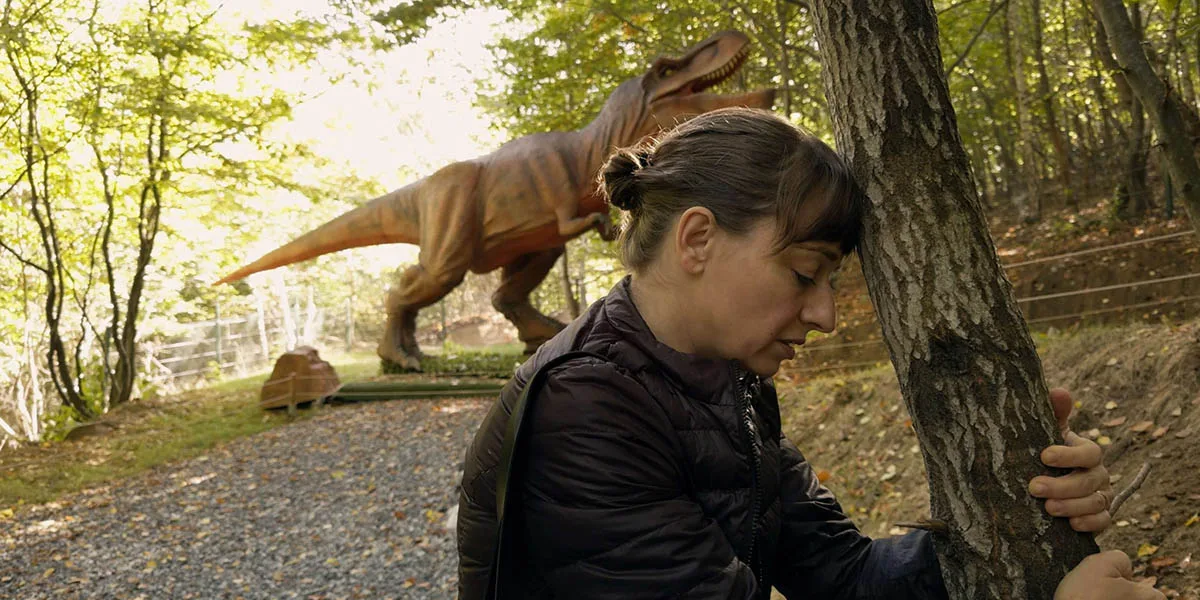
In addition to Jude’s thematic decisions, he still retains his winking visual humor. At one point, Orsolya prays in an animatronic dinosaur theme park called Dino Parc Râșnov. At other times, he uses televisions showing advertisements – his interest in advertising is the main subject of his archival film “Eight Postcards from Utopia” – to frame Orsolya as she tells her stories. The juxtaposition, of course, draws a straight line from the cruel commercialism of modern existence to the primary reason for this man’s death. And while “Kontinental ’25” is rife with other ideas (the war in Ukraine, the genocide in Gaza and anti-Hungarian sentiments in Romania), it’s the easy, gentle distillation of Jude’s wild antics presented as political satire that makes “Continental ’25” its sly declaration that he can make “normal” films, too.
Upcoming Movie Update
Berita Olahraga
News
Berita Terkini
Berita Terbaru
Berita Teknologi
Seputar Teknologi
Drama Korea
Resep Masakan
Pendidikan
Berita Terbaru
Berita Terbaru
Berita Terbaru