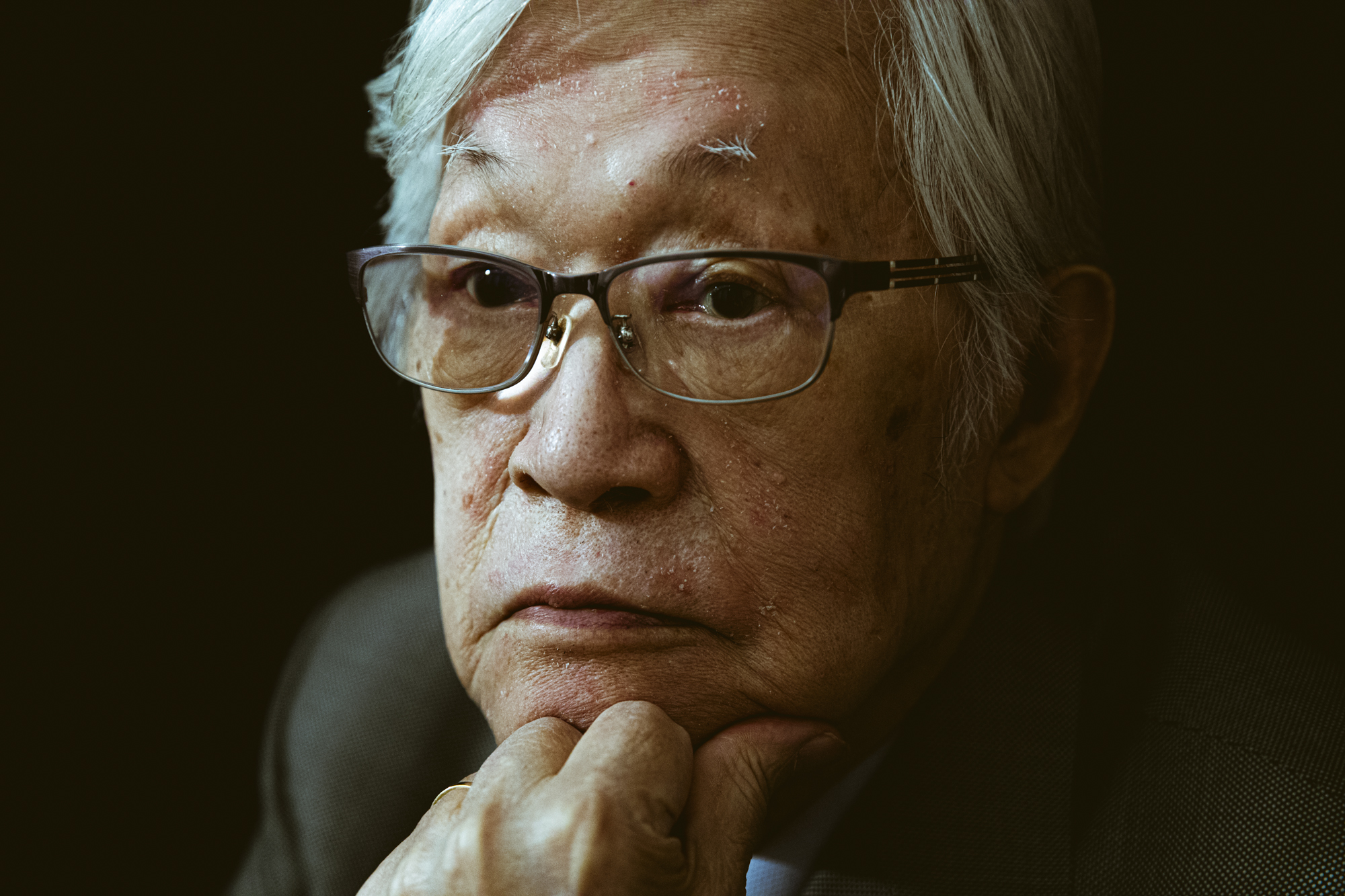
Before watching the documentary about him, I had only heard the name Sato Tadao once. It was in an article by Roger Ebert, an article on the growing popularity of Yasujiro Ozu in the West, in which Ebert called Tadao a “veteran Japanese critic” whom he had met on a trip to Tokyo. Both Tadao and Ebert were great admirers of Ozu, and in the article Ebert lays out a series of the director’s stylistic signatures, attributing them to his Japanese counterpart’s writings on the subject.
Directed by The Teraski Mizuho, “Journey to Sato Tadao” is a biographical portrait that establishes Tadao as one of Japan’s most important film critics. The film is loosely structured around Terasaki’s trip to the southern Indian state of Kerala, where she searches for the people behind Sato’s “real” favorite film, “Kumatty” (1979), by director G. Aravindan. The quotes come from a sequence early in the documentary, in which Sato – who died in 2022, but appears in footage shot by Terasaki before his death – says he has two answers ready when someone asks him his favorite film: a respectable film and a real one. (Ironically, the Roger Ebert article that led me to Sato also opens with an anecdote about recommendations.)
Later in the film. Terasaki and his team are also traveling to South Korea to interview Sato’s friends and colleagues there, as part of a broader discussion about film critics as cultural ambassadors who can make real material changes in the lives of filmmakers by championing them abroad. (I would argue that this is one of the noblest functions of film criticism as a profession, and something I ideally hope to accomplish by writing about the films I see here in Tokyo.) For Sato, this relationship went two ways: not only did he write about Japanese films for foreign readers like Roger Ebert, but he also played an important role in popularizing Indian and South Korean cinema in Japan.
Sato speaks warmly of his friends across Asia in “Journey into Sato Tadao.” Terasaki believes that these connections must have been a relief for the writer who, despite his working-class origins, became a member of the Japanese social elite. But he never felt comfortable there and maintained throughout his life that cinema should be for the people. “Everyone admired him. He was a scholar. People used honorifics to talk to him” in Japan, Terasaki said. “But I felt like people in Korea and India didn’t have that kind of distance between them and him. I think that made him happy,” she says.
Although Sato’s international impact serves as the framework for the documentary, its heart lies in his relationship with his wife, Hisako. “Journey into Sato Tadao” depicts the relationship between Tadao and Hisako as a partnership between true equals, in which Hisako, who was already successful when she met her future husband, was a strong advocate (and present) of his work. In 1973, they co-founded the film magazine “Eigashi Kenkyu”, which is still active today. “Their love story was very colorful,” says Terasaki.
Here is another parallel. Since Roger’s passing in 2013, Chaz Ebert, who also had a successful career in law before meeting Roger, has been the steward of his legacy and editor of the website you are currently reading. And the similarities don’t end there: Sato also published books on cinema and film history, many of which are seminal texts for young Japanese film fans. (He was more prolific than Ebert, however, publishing more than 150 books on various subjects during his lifetime.) And, like Ebert, Sato taught film as well as writing about it.
In the 2000s, Terasaki was a student in one of Sato’s film classes at the Japan Academy of Moving Images, where her first impression was that “he [knew] anything and everything about Japanese films. And every time he talked about a movie, his face lit up like that of a little boy. It showed how much he loved movies. But otherwise, he was not easy to approach. Years later, Terasaki was working as a documentary producer when she was asked to make a documentary about her former teacher, the one she found so intimidating at film school.
“At first I couldn’t really understand his character,” she says. “But then Sato’s niece” gave me a diary he had written when he was about 25 years old. And in that journal, he mentioned his anxiety about the future and his dreams about what he wanted to do. [with his life]. Reading this, I realized that this young Mr. Sato was very approachable, and thus the psychological gap between him and me narrowed and I could relate to him more.
Passages from Sato’s diary, as well as his books, are quoted throughout “Journey Into Sato Tadao.” In choosing these passages, Terasaki said he prioritized writings in which Sato dealt with his current experiences, whether it was his feelings about the devastation of World War II or his thoughts after seeing his new favorite film for the first time. The passage that stood out to me the most concerns writing: “When I write it, that’s when I start to see what I’m thinking. When I’m not writing, I don’t know what I’m thinking,” Terasaki quotes Sato as saying.

Although she’s not a critic herself – in typically modest Japanese style, she says she keeps a diary of the films she’s watched, but doesn’t share it with anyone – the more we talked, the more I realized Terasaki and I had in common. Not only are we women of the same generation working on projects about older male critics who inspired us early in our careers, but we are also both dedicated movie buffs. His favorite film is “Pigs and Battleships” by Imamura Shohei (incidentally, also the founder of the school where Sato eventually taught), and he hopes to film something as good as his ending one day. She has been attending the Tokyo International Film Festival for years, although this is her first time presenting a film at the festival.
The movie culture in Japan is strong, but insular, Terasaki says. “We have a wonderful library at the National Film Archives, so these films are preserved, but we are not very good at using the archives to the fullest and showing them to the public. They have screenings, but only movie buffs attend, not the general public. So I hope there will be chances that ‘ordinary people’ will have a chance to see these old Japanese films and become more interested in the history of Japanese cinema, because it is a fascinating subject.”
When I explain to her Roger Ebert’s famous quote about cinema as an “empathy machine”, she recalls in response another quote from her former cinema teacher. In her book “Can You Love the World Through Movies?”, Sato “left the words that movie is like a greeting, meaning you can show the world what kind of country you are, or what kind of person, or culture, through movies. Then you can learn about that country, or learn to love it, through its movies,” she says.
At the end of our interview, the translator told me that Terasaki also had a question for me: Was there a documentary about Roger Ebert? I said, yes, it’s called “Life Itself.” “Ah! I watched this as research for my film,” Terasaki replied. Turns out she’s also a Steve James fan.
Upcoming Movie Update
Berita Olahraga
News
Berita Terkini
Berita Terbaru
Berita Teknologi
Seputar Teknologi
Drama Korea
Resep Masakan
Pendidikan
Berita Terbaru
Berita Terbaru
Berita Terbaru