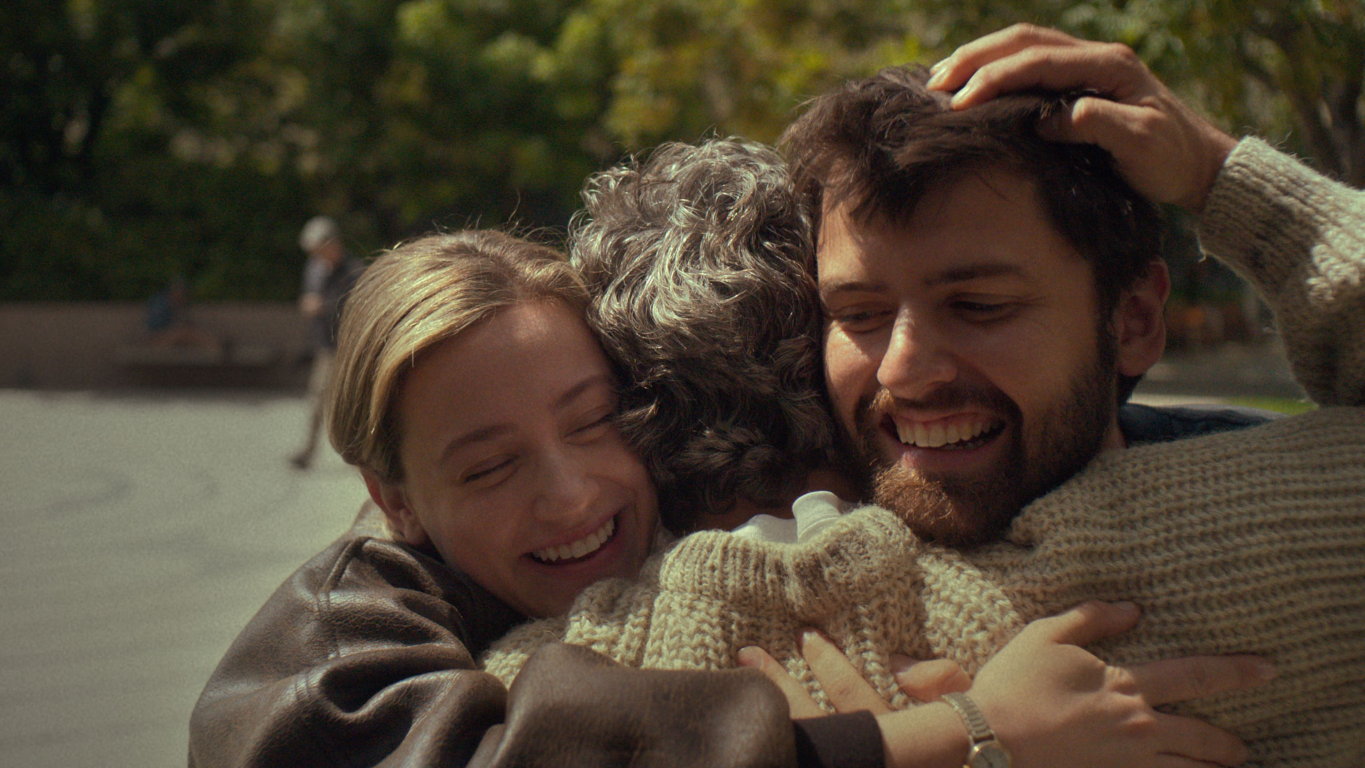
The final episode of Cooper Raiff’s eight-part series, “Hal & Harper,” opens with a dedication: “For parents and the parentified.” At its best, the series evokes this love and care for the struggles and anxieties of parenthood, as well as the developmental arrest that occurs when children are forced to parent themselves. As a young filmmaker with two eye-catching features already under his belt — 2020’s “Shithouse” and 2022’s “Cha Cha Real Smooth” — Raiff’s work has often dealt with the tensions of growing up and putting childish things aside. But here, it’s told with remarkable patience and assurance, even if Raiff often gets in his own way.
Told elliptically and jumping in time across several decades, “Hal & Harper” focuses on a troubled family struggling to cope with loss and trauma; we quickly understand that the mother tragically dies when the two children are very young, emotionally freezing them in place. The titular children are nervous Hal (Raiff) and his older sister Harper (an incredible Lili Reinhart), first seen in their early 20s, still figuring out their lives. Hal feels like a kid navigating college with a best friend who tells him he’s “not, like, a person sometimes,” all frayed nerves and an eagerness to please people.
Harper, meanwhile, is fresh out of college, works hard at an entry-level office job, and is in a six-year relationship with her first love, Jesse (Alyah Chanelle Scott), that she can’t bring herself to leave, even though she’s already left school. An adventure with a colleague (Addison Timlin, also a producer) gives him the opportunity to experience something exciting and new. Yet she’s stuck: stuck in the limbo of her existing relationships with Jesse, Hal and her guilt-ridden father (Mark Ruffalo). They all depend on each other in ways that can offer peace but also hold them back; Hal and Harper’s lack of boundaries, even as adults, is quickly seen as unhealthy.
While the first two episodes cement the montage-y, impressionistic nature of the series—much of the show’s running time takes place in breezy intercuts over weepy indie-folk needle drops from acts like Phoebe Bridgers and Waxahatchee—it’s at the end of episode 2 that we see one of Raiff’s most ambitious stylistic choices: we’ve returned to 2009, as Hal and Harper are entering first and third grade. Instead of casting children, Raiff and Reinhart, in their 20s, play the roles instead; the former adjusts his physique to play with preteen awkwardness, while Reinhart’s Harper always smokes and makes jokes about drinking. “You really had to grow up too fast,” Dad said to them, and to us, hammering home this vanity.
It’s a cloying, awkward moment to sell the mood, and “Hal & Harper” has plenty of it. When watched all at once, the series’ sleepy, waxy tone can sometimes irritate, as the overwhelming sweetness of its presentation and the simplistic, unfocused comedy-drama wear thin.
This attitude is pervasive in Raiff’s work, particularly in “Cha Cha”; especially on screen, Raiff’s presence is something of a weak point, as his wide-eyed enthusiasm can destroy his most charming moments as an actor. His works particularly focus on the dissonance between childhood and adulthood, and the attraction to the simplicity of childhood for security.
“Hal & Harper” gleefully plays with the divide between adults who can’t let go of their childhoods and who are a little too grown-up to experience childhood well. The rhythms that explore this thrill are among the most successful in the series. The problem comes from the awkward and choppy structure of the series. Because we navigate so much in time, it’s difficult to understand these characters or their conflicts, and they don’t get a chance to build organically.
Structuring a show achronologically should create meaning in these intercuts; alas, we have to juggle two or three different conflicts at once that are not resolved satisfactorily. Some subplots, like Dad’s girlfriend (an underused Betty Gilpin) struggling with the possibility of their unborn child having Down syndrome, feel tacked on and perfunctory, and the larger question of “can they handle selling their childhood home?” doesn’t spill over boldly enough into their larger lives to feel important.

What elevates the show’s hazy presentation are the performances of Reinhart and Ruffalo, each of whom finds remarkable notes of grace in their prickly, complicated characters. Reinhart’s Harper feels like the adult in the family, for lack of a better term; she always had to take care of Hal And his father in a way, and this moment in his life plays out like a deeply painful crossroads. She’s a jerk, trapped in cycles of self-destructive behavior because she doesn’t know what she wants. Reinhart’s expressive face speaks volumes, whether of guilt, memories, or conflicts, in a way that the sparse, overly sentimental script does not allow.
Ruffalo, for his part, is often absent on his own show, playing the emotionally closed-off father who withdraws to deal with his trauma. This isolates his character somewhat from the rest of the series, but it gives him a nice showcase to mark his hangdog expression, filled with decades of heartbreak and sorrow, in a way that resonates when he’s the center of attention.
When we face loss, time can seem to stand still. I know; As I write this, I myself am waiting to find out if my maternal grandmother, the matriarch of our family, will pass away today. It’s one of those terrifying prospects that no amount of emotional fortification can really prepare you for. In its final hour, “Hal & Harper” captures the bittersweet nature of change and how closing one chapter can help you open another. But perhaps that’s proof enough that there’s a solid three-star movie concept here, rather than stretching it out into a loose, thin five-hour TV series.
The entire season was screened for review. Premieres on MUBI October 19.
Upcoming Movie Update
Berita Olahraga
News
Berita Terkini
Berita Terbaru
Berita Teknologi
Seputar Teknologi
Drama Korea
Resep Masakan
Pendidikan
Berita Terbaru
Berita Terbaru
Berita Terbaru