
Since 2025, it seems no story has been adapted as frequently as that of the folk legend Robin Hood. Adaptations of fables and popular literature have recently played with their source material, presumably in an attempt to satisfy audiences tired of traditional stories. Yet MGM+’s “Robin Hood” dismantles that notion, stripping away all the excess and delivering an adaptation of the famous story that feels like it belongs in a different era of television, for better or worse.
Set in 1186, the series presents a time when the Normans have long since invaded England and Christianity has been imposed on the Saxon people and their lands. We watch as a young boy is told stories of gods of the past and learns how his family’s home and titles were taken from them.
This boy grows up to be Robin “Rob” Locksley (Jack Patten) – later called Robin Hood by his allies and enemies – a man desperate to carve out a place for himself in a world that seems determined to destroy him and those close to him. After a devastating loss, Rob is forced to take matters into his own hands to challenge current politics, sparking a new era of rebellion that threatens to shake the foundations of England.
Unlike many adaptations that follow the titular hero that have been released over the past two decades, the MGM+ version of this story is surprisingly interested in ideas of sovereignty and ownership. At the very least, this version of the story shows its hero’s politics squarely, proving that he was radical not only in the legendary era in which he existed, but even in the current era from which we watch his story unfold. It’s a refreshing theme that’s woven into the very foundation of “Robin Hood,” one that can’t be smothered even under the weight of the show’s many flaws, some of which are so irritating that they threaten to stall the show’s goodwill.
In a post-Game of Thrones world, series set in medieval times will inevitably be compared to iconic series. But where “Thrones” knew how to juggle interpersonal relationships with dazzling action sequences, almost no other show has come close. The same is unfortunately said for “Robin Hood,” which struggles to hook you with its dull romances and sometimes superficial political intrigue. It looks like the story has finally reached its climax when Rob’s group of Merry Men reunites, featuring Drew (Matija Gredić), Henry (Mihailo Lazić) and Ralph Miller (Erica Ford), Little John (Marcus Fraser), Friar Tuck (Angus Castle-Doughty) and Spragart (Ryan Gage).
Each member of this group of misfits builds not only a believable bond between them, but one that makes the series even more intriguing than it is when they’re not on screen. At its core, the story of Robin Hood is one of finding love and strength in community. This is often removed from Hollywood versions of this story, which instead prioritized action scenes over any in-depth engagement with the ideas of the found family trope. Here, the most interesting part of the series is this ragtag group finding comfort in each other and is far more engaging than the politics of nobles that the series attempts to expand upon over the course of its 10 episodes. Fortunately, even when the plot falters, “Robin Hood” is a rare series that easily emulates its era with its visual and musical prowess.
While the daytime sequences of the series don’t have much to offer, with desolate earthscapes exposing what can be considered low budget, when nighttime arrives the series really shines. Unlike other medieval series that have dominated our screens in recent years, cinematographer Ivan Kostić has an innate understanding of how to light and frame a scene that should be large-scale. What he achieves are images in which the halls of the nobles and the faces of our characters are bathed in the glowing light of candles and bushfires, illuminating beautifully crafted robes, jewelry, and finery of gold and silver.
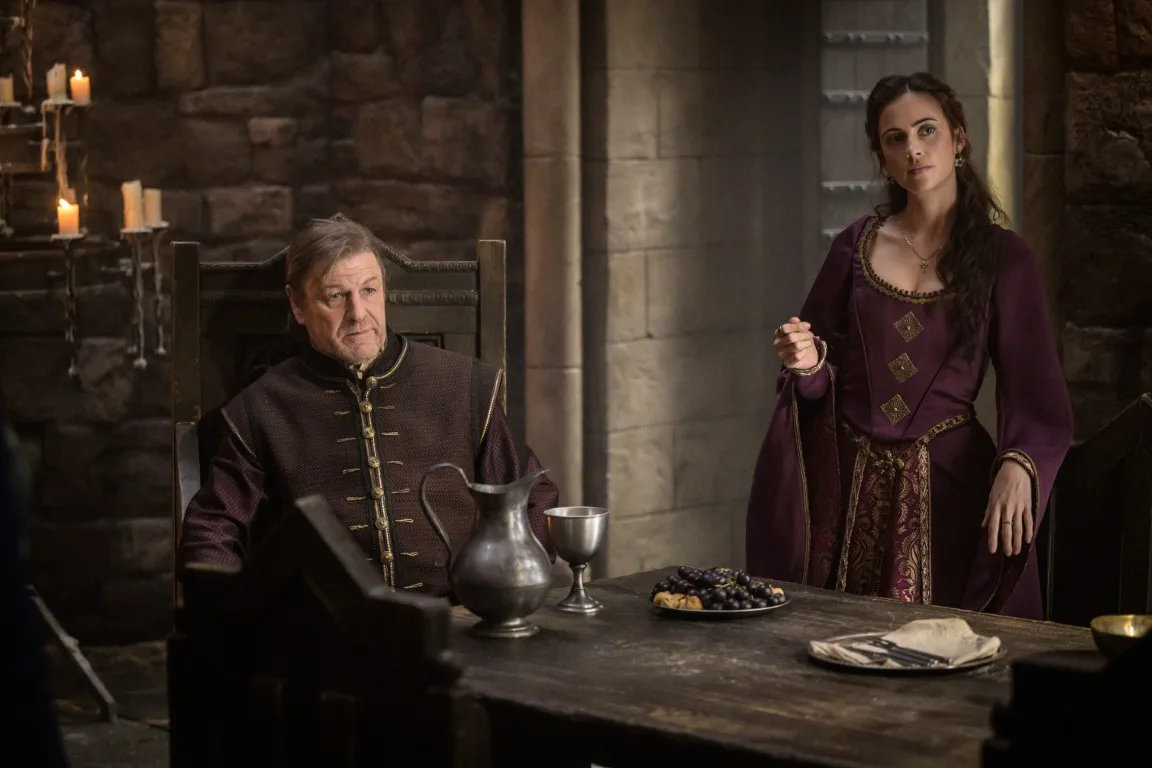
Paired with a stunning score by composer Federico Jusid where strings sing and ebb through every scene, “Robin Hood” easily enchants you with its talent, even when its plot begins to slip through your fingers. But, while the show’s nighttime visuals and music are undeniable highlights, everything else about the series feels like it’s being kept at an uncomfortable distance from the audience. An unintentional barrier separates the viewer from the story they are meant to be engaged in throughout this first season, leaving in its wake a stilted narrative that never reaches the heights that such a beautifully crafted show should deserve.
For a series that will inevitably be described as “Game of Thrones” without magic, the romantic couples – and even some of the show’s platonic couples – on this show lack the substantial chemistry necessary to make these relationships feel lived-in. Small moments between the main group are abandoned in favor of attempts at world-building that simply don’t work for a story that, at its core, should be on a smaller scale. As Rob’s cause grows, the series loses sight of what once made it so engaging, becoming bloated almost beyond repair. In attempting to expand the series beyond its quaint beginnings into the next great medieval series, “Robin Hood,” it quickly stretches itself so thin that by the end of this first season’s 10 episodes, it becomes difficult to justify its existence.
Upcoming Movie Update
Berita Olahraga
News
Berita Terkini
Berita Terbaru
Berita Teknologi
Seputar Teknologi
Drama Korea
Resep Masakan
Pendidikan
Berita Terbaru
Berita Terbaru
Berita Terbaru