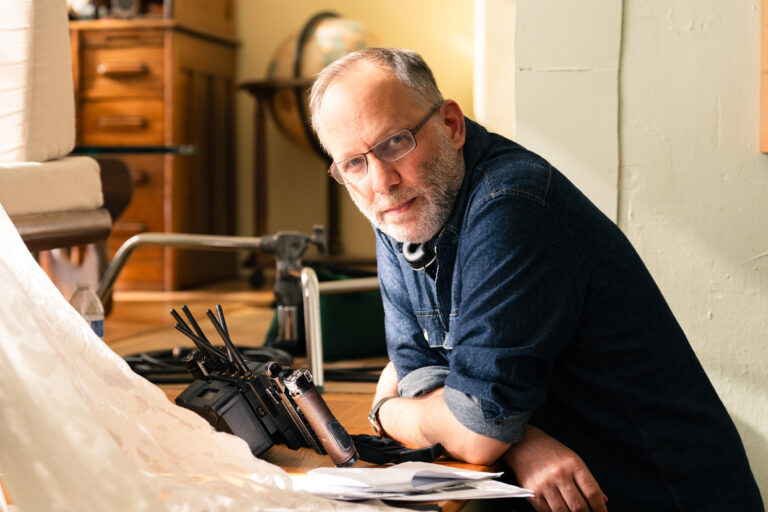
In December 1974, two close friends talked while a tape recorder captured their conversation. It was part of a project Linda Rosencrantz was working on, asking her friends in the art community to tell her the story of their day. Ira Sachs’ new film, “Peter Hujar’s Day,” is a meditation on art and friendship, based on the transcript of this conversation with Ben Whishaw as photographer Hujar and Rebecca Hall as Rosencrantz. In an interview, Sachs talked about what a director has in common with a psychoanalyst, his use of light to tell a story, and the rare friend who really listens.
You use light in a very interesting way throughout the film, beyond just setting the location and time of day..
It’s almost as if the story of light is the story of film. It is the story of a day, the story of the passing of time, the story of the portrait, Hujar clearly being a portrait painter, of humans, animals and objects. And for me, light conveys an emotion based on space and time. It’s really a bit like the second text of the film. There is the text of Peter Hujar describing his day, and then there is the text of the characters of Peter and Linda over the course of a day, in this space. It also evokes the emotion of time, which is perhaps what the film is really about. So I tried to use cinematic means to share this with the audience.
There’s something captivating about telling someone about your day in such detail and getting them interested in it all..
Peter Hujar is he is also a particularly gifted storyteller in the sense that if you asked me to tell you what I did yesterday, it would not be as rich as what Peter is capable of doing. He is truly an extraordinary narrator. Just as details are details of something written but not written. It’s also in Ben’s performance. He took an approach in which there is a kind of egalitarianism. All the points that are made without being boring or monotonous, you know, monotonous, there’s also a great range of feelings um, he’s not particularly um, he’s not an analyzing storyteller but he’s revealing and for me the power of film is really an artist revealing his vulnerability and how difficult it is to make good art.
One of the things that interested me most about the film was what it means to have a listener like that. It is possible for a psychoanalyst to also be present and engaged, but it is a very different relationship.
That’s the only other job I could have taken, as an analyst, because the way Linda listens to Peter is how I feel as a director. I have to listen to my actors. I need to listen with incredible rigor. And Linda does it so well through Rebecca. What Rebecca understood, because she knew Linda, like me too, is that she is a very generous, curious, empathetic and attentive person. But there was also an inherent trust between the two of them that allowed Peter to take the plunge and speak for so long about his life.
They have been friends since they were out of their teens. And for me, that’s the only element of the film that’s really familiar to me is that it reminds me of my friendships as a gay artist and a gay man with some of the friends in my life. Very few, but one or two who seem to love me the same way Linda loved Peter.
How did you talk to Ben and Rebecca about what you expected of them?
With Ben and I, it was very instinctive because we already worked together on “Passages”. Part of the reason I thought about making this film is that I enjoyed my collaboration with him so much that I wanted to find something to continue, which I still feel today. I want to find something else to do with Ben. And Rebecca is someone I met right before we started filming. What they have in common is that they are both actors who are primarily interested in living a creative life.
What I discovered during the pandemic was that when I didn’t have that, I didn’t have a relationship with myself that felt alive. I felt very dead. Because I think that the conversation we have with ourselves, whether it’s positive or negative, as Peter shows us, is sometimes a very negative conversation of doubt. Sometimes it’s about trust, but it’s active and it’s intimate. And I think for me it’s necessary.
I would love to hear about the music, not just the sound and the percussion and the melody, but also how we hear it in the film.
I think it’s important for a film to wake up the audience. Sometimes, for me, that means bold cuts. In some of my films, I don’t want things to stay too comfortable. I don’t want them to go to sleep knowing what they’re getting. And the music was a tool, as were some of the artificial elements in the film, to create a disconnect for the audience, which then allowed them to connect in new ways.
There are many names in the film, some we recognize, like Allen Ginsburg, others who are not part of our current cultural conversation. Does it matter who they are?
For me, it’s not important at all. I mean, no one, including Linda or myself, knows who all these people were. They make up the cast of characters in that character’s life, and that’s what’s significant. I mean, they’re only as good as Ben makes them come alive. That’s what really surprised me myself, in Ben’s performance, how alive every name, every image, every feeling, every taste is, it’s a very alive performance. And if that wasn’t the case, it wouldn’t have made a feature film. So for me, there are a lot of names. You know them because Ben makes them real, not because they are famous.
Rebecca makes Linda very lively too, even though she has very few lines.
Linda is an extraordinary person. And I think his understanding that the way we speak in everyday life is artful and meaningful is beautiful.
Upcoming Movie Update
Berita Olahraga
News
Berita Terkini
Berita Terbaru
Berita Teknologi
Seputar Teknologi
Drama Korea
Resep Masakan
Pendidikan
Berita Terbaru
Berita Terbaru
Berita Terbaru