Short Film Focus: 24 Hours After Reading Tuesdays with Morrie (with Scott Tinkham) | Short films in brief


I’m not sure I’m fully qualified to write this review, although I have seen Scott Tinkham’s “24 Hours After Reading Tuesdays with Morrie” several times. I almost…almost— scheduled it for the Chicago Critics Film Festival this year, but blinked, guessed, and maybe chickened out. “Will people understand this? I get it? Is “Tuesday With Morrie” a reference point that will appeal to the young audience who comes to our festival? These are the questions that tormented me. It’s almost the opposite experience of that of the main character in the film.
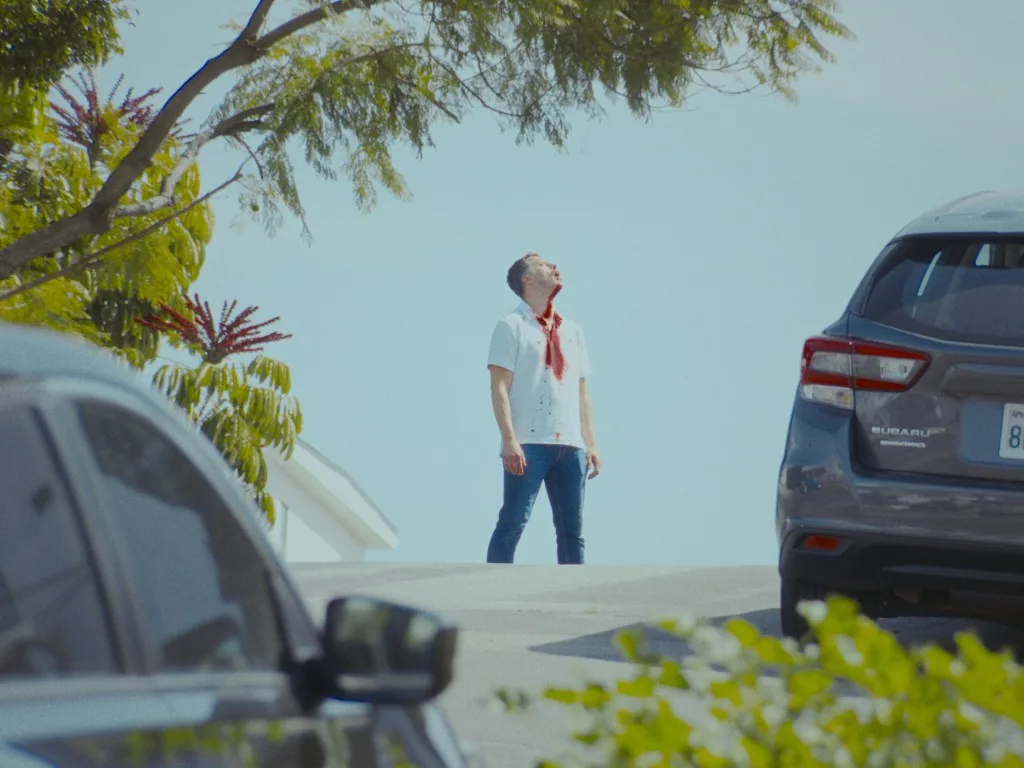
In it, a man finishes the last pages of Mitch Albom’s very famous book, “Tuesdays With Morrie.” He turns the last page and suddenly undergoes an absurd level of spiritual awakening, transforming him into a wandering, wide-eyed idiot whose inner dialogue resembles a bad imitation of a Terrence Malick film.
He walks through traffic while looking at palm trees and admiring their beauty, while people going about their day stare at him, perplexed and probably filming him for TikTok videos. His girlfriend leaves him, but he remains determined to notice and feel connected to the oneness of the universe. That is, until someone violently tried to make sense of it.
The less you know after this point, the better. Tinkham’s film may be an odyssey of a single joke, but it’s a joke I don’t often see played out. Whether we want to admit it to ourselves or not, many of us have connected with a work of art the way this character does, and we come away believing that we have been changed forever. But are we? Of course, I remember reading Carl Sagan’s “Contact” for the first time and feeling like another window on the universe had opened, but not literally. Eventually, I had to come back to the real world and put aside how I felt about the vastness of the cosmos and our small size. This character refuses to escape, and Tinkham exploits this idea for much of the film’s humor.
I’ve never read “Tuesday With Morrie”, which may be why I feel underqualified to write about it, but I still find the film very funny and can’t wait to see what Tinkham does next. Many have pointed out that this is a funny exaggeration of how people respond to the book. I’ll have to take their word for it. Sometimes, to be interested in art, you have to admit that you don’t understand everything, but that you can still find a way to appreciate it simply by stepping outside yourself. It may not be as satisfying as ending up in an obscure reference, but if I had skipped this film because of its title, I would be missing out on a strange little number that I ended up enjoying.
Q&A with writer-director Scott Tinkham
How did this happen?
This has come to fruition in a thousand different ways. But there was a strange unlocking that happened when I read “Tuesdays with Morrie.” After finishing it, I came away with a strange feeling of clarity about life. Not just a sense of aliveness and presence, but a flood of bizarre epiphanies. They began to sprout in my head as poetic lines as I waltzed around town like a drugged out guy. I remember standing on the stairs of Planet Fitness, looking around at this crowded gym, and in a completely nonchalant state of mind, thinking, “Look at all these creatures taking care of their meat vehicles just to live a healthy life.” Borderline psychotic. I spouted these “truths of life” by the dozen. Moral of the story: I wrote this film as an exploration of this strange day, taken to the extreme.
How did you find Mat Wright?
About five years ago I was sent this short film, “Craig’s Pathetic Freakout,” by Graham Parkes, starring Mat Wright and Lewis Pullman. It quickly became one of my favorite short films. After writing this film, I contacted Mat and, miraculously, he connected and wanted to meet me. The rest is history.
Did Mat Wright have to read “Tuesdays with Morrie” to help him get into character?
I’m pretty sure the first time he deciphered the book was when he was reading it in the first shot of this movie. He read it to the end a few months after we wrapped it and immediately started bleeding from his eyes and nose.
I’ve never read the book, but I still understand where the movie comes from and why it’s funny. Is this a common reaction?
Yes, absolutely. It is also aimed at those who have never heard of the book. It’s strange, but I think it’s ultimately because people can immediately relate to being moved by a work of art, anything that has perspective-altering power. It could be a film, a painting, a song, a conversation with a friend, anything. This book happens to be about a man who takes care of his dying teacher every Tuesday.
Apart from this one, Has there been a book, painting, film or piece of music that affected you in this way?
So much stuff in all different mediums. Even simple experiences or conversations with close friends or family. When something really affects you, all you want to do is shout it out to the world and share it with everyone, because it feels like a profound revelation. But the sad truth is that you have to fight against yourself to maintain this new perspective. This is the heart of this film. Wanting to live in a new, newly discovered headspace, thinking you are forever changed, but having to fight the part of yourself that wants to return to its natural stasis. This is something I struggle with every day and it makes me wonder if real change is really possible.
What’s next for you?
I’m making a feature film called “Good Life.” I really can’t wait for people to see it. It’s similar in tone and feel to that short, and in many ways it’s a spiritual successor. It has the same existential weight, but it’s matched with humor, heart, and primal themes of death and love. I hope this makes people laugh and squirm.
Upcoming Movie Update
Berita Olahraga
News
Berita Terkini
Berita Terbaru
Berita Teknologi
Seputar Teknologi
Drama Korea
Resep Masakan
Pendidikan
Berita Terbaru
Berita Terbaru
Berita Terbaru